|
情意教育經典研讀會-主讀講稿 |
|
Peirce (1) -- Division of Signs |
| 主讀人:曾月紅教授(國立花蓮教育大學英語教學學系教授) |
| 日 期:2007.03.06 |
|
Division of Signs Meaning Construction “A sign, or representamen, is something which stands to somebody for something in some respect or capacity. It addresses somebody, that is, it creates in the mind of that person an equivalent sign, or perhaps a more developed sign. That sign which it creates I call the interpretant of the first sign. The sign stands for something, its object.” (Peirce, 1931-1960, p. 135) Peirce (1984, pp. 2.228) 認為「記號(sign)是某物對某人所代表某種意義,記號向某人示意時,那一個人會產生相等的記號或是更進一步的記號(sign),此新記號可以稱做第一個記號的符義體(Interpretant),記號本身代表某個物件」。(Peirce, 1931-1960, p. 135 in Tseng, 2005, p. 84) “228. The sign stands for something, its object. It stands for that object, not in all respects, but in reference to a sort of idea which I have sometimes called the ground of the represetamen." (Peirce, 1931-1960, p.135) 「記號代表物件,但並不代表物件的全部,而是參照某種想法,此某種想法就是記號的根基。」(Peirce, 1931-1960, p. 135, in Tseng, 2005, p. 87) Sign is: “Anything which determines something else (its interpretant) to refer to an object to which itself refers (its object) in the same way, the interpretant, becoming in turn a sign and so on ad infinitum” (Peirce, 1931-1960, p. 169) Sign

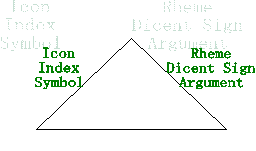
Object Interpretant Sign and their Objects Relationship between Sign and Object “230. The word Sign will be used to denote an Object perceptible, or only imaginable, or even unimaginable in one sense” (Peirce, 1931-1960, p. 136). Example: “for the word ‘fast,’ which is a Sign, is not imaginable, since it is not this word itself that can be set down on paper or pronounced, but only an instance of it, and since it is the very same word when it is written as it is when it is pronounced, but is one word when it means ‘rapidly’ and quite another when it means ‘immovable,’ and a third when it refers to abstinence.” (Peirce, 1931-1960, p. 136) Sign can have one object For example, map represents one point on the actual land. Signs can have various objects or one complex object For example, the sentence, “Cain Killed Abel” involves three different objects: Cain, Abel, and Killing. Sign represents Object “231. The Sign can only represent the Object and tell about it. It cannot furnish acquaintance with or recognition of that Object; for that is what is meant in this volume by the Object of a Sign; namely, that with which it presupposes an acquaintance in order to convey some further information concerning it.” (Peirce, 1931-1960, p. 137) “The Objects—for a Sign may have any number of them—may each be a single known existing thing or thing believed formerly to have existed or expected to exist, or a collection of such tings, or a known quality or relation or fact, which single Object may be a collection, or whole of parts, or it may have some other mode of being, such as some act permitted whose being does not prevent its negation from equally permitted, or something of a general nature desired, required, or invariably found under certain general circumstances.” (Peirce, 1931-1960, p. 138) Example: “232 Two men are standing on the seashore looking out to sea. One man told another ‘That vessel there carries no fright at all but only passengers.’” (Peirce, 1931-1960, p. 137) One trichotomy of Signs Qualisign “A Qualisign is a quality which is a sign” (Peirce, 1931-1960, p. 142) Sinsign “A Sinsign…is an actual existent thing or event which is a sign” (Peirce, 1931-1960, p. 142) Legisign “A Legisign is a law that is a sign” (Peirce, 1931-1960, p. 142) Second trichotomy of Signs Icon: “An Icon is a sign which refers to the Object that is denotes merely by virtue of characters of its own, and which is posses, just the same, whether any such Object actually exists or not” (Peirce, 1931-1960, p. 143) Index: “An Index is a sign which refers to the Object that is denotes by virtue of being really affected by that Object” (Peirce, 1931-1960, p. 143) Symbol: “A Symbol is a sign which refers to the Object that is denotes by virtue of a law, usually an association of general ideas, which operates to cause the Symbol to be interpreted as referring to that Object. (Peirce, 1931-1960, p. 143) A Third Trichotomy of Signs Rheme: “A Rheme is a Sign, which, for its interpretant, is a Sign of qualitative Possibility, that is, is understood as representing such and such a kind of possible object.” (Peirce, 1931-1960, p. 144) A Dicisign: “A Dicisign is a Sign, which, for its interpretant, is a Sign of Actual existence.”(Peirce, 1931-1960, p. 144) An Argument: “An Argument is a Sign which, for its Interpretant, is a Sign of law” (Peirce, 1931-1960, p. 144) Sign (Qualisign, Sinsign, Legissign)
Object Interpretant
Example: I. Rhematic Iconic Qualisign Feeling Red II. Rhematic, Indexical, Sinsign Door Bell, Foot Print Reference Peirce, C. S. (1931-1960). "Division of Signs." In Charles Hartshorne and Paul Weiss (Eds.), Collected Papers of Charles Sanders Peirce (Vol. 2). Cambridge, Mass.: Harvard University Press. 曾月紅(2005). 讀者角色的轉換─以記號學為教育理論的基礎 師大學報師大學報─教育類 50, 1, 79-100. |