|
||||||||
|
A Brief Introduction to Electoral Systems* |
||||||||
|
|
||||||||
|
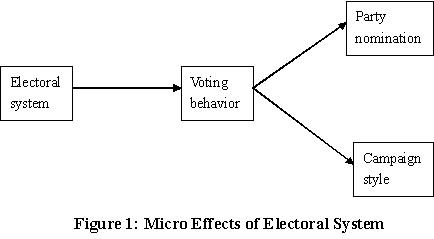
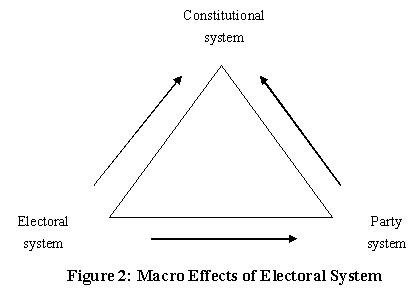
Dr. Cheng-Feng Shih(施正鋒) Professor, Department of Public Administration and Institute of Public Policy Tamkang University, Tamsui, Taiwan Electoral systems are not equivalent to electoral laws; rather, they are mechanisms that translate votes into seats in legislative as well as executive elections. That electoral systems matter is testifies by the fact that parties with the same votes may receive disparate percentages of seats under different electoral systems. In the Third-Wave of democratization, electoral engineering has been considered crucial for successful political engineering, if not manipulation. Electoral systems have both micro and macro political consequences. On the one hand, electoral systems, as political institutions, while directly acting upon voters’ behavior, would ultimately provide incentives for and barriers to political parties and candidates in the process of nomination and of campaign (Figure 1). On the other hand, electoral systems would produce three systemic effects: proportionality of the seat in relation to the vote parties receive, the number of parties, and minority representation. While the former are termed psychological effects, the later mechanical ones. When electoral systems and their impacts on the party system are waged against the constitutional system already adopted, whether they are synchronized will decide how the political system may operate smoothly (Figure 2). Political scientists would generally agree that proportional electoral systems are conducive to multi-party systems, plurality ones to two-party systems, and majority ones to two-camp systems. As it has been suggested by some that multi-party systems are incompatible with presidential systems, the logic goes, either the constitutional system has to shift gear to a parliamentary one or a non-proportional electoral system has to be devised.
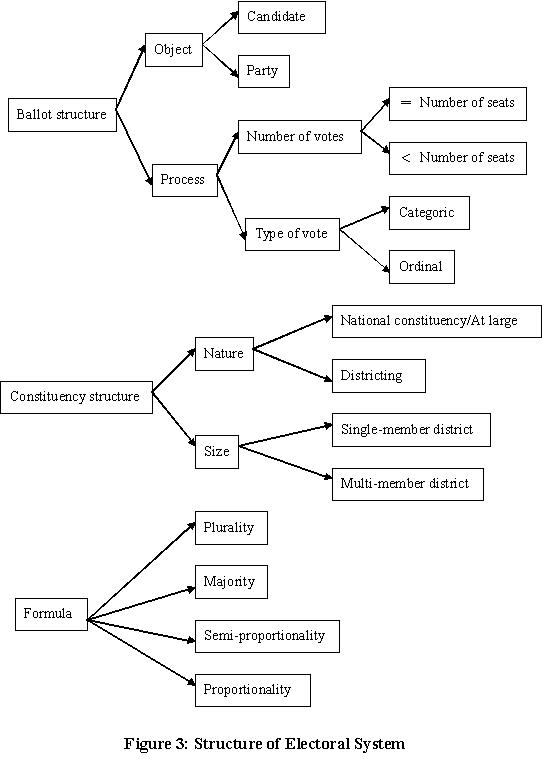
The structure of electoral systems has three major components: ballot structure, constituency structure, and translating formula (Figure 3). First of all, the balloting structure is composed of two dimensions: to whom the vote goes (candidate or party), and the process of voting, which is in turn decomposed into the number of votes (equal or smaller than the number of seats) and the type of vote (categorical or ordinal). Secondly, the constituency structure has to decide its nature (either at large or districting), and size (single-member or multi-member district). Last but not least, we have to choose from among the following translating formulae: plurality, majority, semi-proportionality, and proportionality. If we focus on the translating formula, we can come up with two ideal types of electoral system, plurality/majority and proportional representation, along with semi-proportionality and some so-called mixed systems (Figure 4). Within the plurality camp, first-past-the-post is most popular in countries under Anglo-Saxon influence while various form of block votes are also adopted. Under the majority branch, two-run systems are simple but cumbersome if no candidate receives majority of the votes; alternative votes appear fairer for voters as they may express their preference for the candidates while casting their votes. For most of Western and Northern European countries, they seem satisfied with proportional representation in the form of party-list even though Ireland enjoys the single-transferable vote that allows voters to cast ordinal votes. The most amazing proportional representation system is the mixed-member proportionality system (also termed additional member system), invented by Germany and imitated by New Zealand, one that guarantees both representatives’ close contact with their constituencies and proportionality.
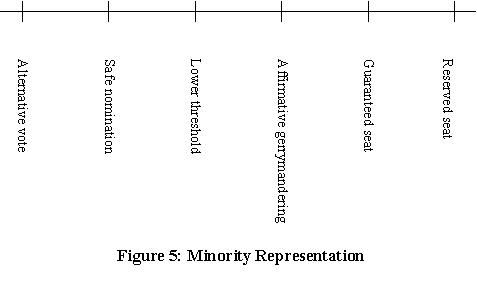
Of course, we should not leave behind the semi-proportional representation system that has just been abolished in Taiwan earlier this year but is still employed by some countries in the Middle East, the single-non-transferable vote. In the 1990s, we witnessed burgeons of some mixed systems, also know generically as parallel systems. As the name suggests, they are designed after assorted combinations of proportional representation and first-past-the-post constituencies. Compared to the mixed-member proportionality system mentioned earlier, these mixed systems are only partially proportional depending on the weight of the proportional representation. It is noted that the electoral system for legislative elections since 1992 have be syntheses of single-nontransferable-vote and proportional representation. Starting from the legislative election in 2007, it will be adjusted to a mixture of first-past-the-post and proportional representation. If the political science wisdom is correct, it is expected that the fragmentation and thus the centrifugal tendency of the party system may be alleviated. As a result, a popularly elected president can be more accountable to the voters even under divided government, that is, when the opposition controls the legislative branch. Finally, if a country is endowed with ethnic diversity, there are some ingenious efforts at ensuring effective minority representation, ranging from reserved seats for the indigenous peoples in Taiwan and New Zealand; guaranteed seats for national minorities in Croatia, Slovenia, and Romania; affirmative gerrymandering for the Black and the Latinos in the U.S.; lower thresholds for ethnic parties in Germany and Poland; nominating minority candidates in safe constituencies, or ranking minorities higher on the party list; and utilizing alternative votes to incorporate minorities’ perspectives (Figure 5).
* Presented at the Conference on Electoral Reforms sponsored by the Democratic Pacific Union, Foreign Service Institute, Taipei, 2005/12/4.
|
 E-mail: